
top of page


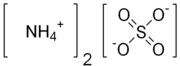
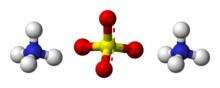
| Product Name: | Ammonium sulfate | Other Name: | Sulfuric acid ammonium salt (1:2);Sulfuric acid diammonium salt;Ammonium sulfate (2:1);Ammonium sulfate;Dolamin;Ammonium sulfate ((NH4)2SO4);Diammonium sulfate;Diammonium sulphate;Ammonium sulphate;Coaltrol LPA 40;Sulfuric acid,diammonium salt;Para-Go;Nonnen R 999-10;Actimaster AMS;Tasker Clear;Busan 1215;Oxamine 6150;122364-22-1;122393-13-9;44071-93-4;57973-73-6;64006-53-7;82168-61-4;428816-32-4 |
| CAS No.: | 7783-20-2 | Molecular Formula: | H3N.1/2H2O4S |
| InChIKeys: | InChIKey=BFNBIHQBYMNNAN-UHFFFAOYSA-N | Molecular Weight: | 132.14 |
| Exact Mass: | 132.020477 | EC Number: | 231-984-1 |
| UNII: | SU46BAM238 | DSSTox ID: | DTXSID1029704 |
| Color/Form: | White or brown orthorhombic crystals|Orthorhombic crystals or white granules|Brownish gray to white crystals according to degree of purity | HScode: | 31022100 |
| Categories: | Acidity Regulators |
| PSA: | 90.6 | XLogP3: | 0.75190 |
| Appearance: | Yellow to orange Solid | Density: | 3 @ Temp: 50 °C”>1.769 g/cm3 @ Temp: 50 °C |
| Melting Point: | 336-339 °C (decomp) | Boiling Point: | 330ºC at 760 mmHg |
| Flash Point: | 26 °C | Refractive Index: | n20/D 1.396 |
| Water Solubility: | H2O: 77 g/100 mL (25 ºC) | Storage Conditions: | 2-8°C |
| Vapor Pressure: | <1 Pa (25 °C) | Toxicity: | Oral-rat LD50: 3000 mg/kg; Abdominal cavity-mouse LD50: 610 mg/kg |
| Flammability characteristics: | Flammable; heat produces toxic nitrogen oxides, sulfur oxides and ammonia fumes | Explosive limit: | May explode if mixed with oxidizers, such as potassium nitrate, potassium nitrite and potassium chlorate. |
| Odor: | Odorless | PH: | pH = 5.5 (0.1 M aqueous solution) |
| Experimental Properties: | Average specific heat capacity: 1.423 J/g-K at 2-55 °C; heat of solution on dissolution of 1 mol in 400 mol water: +9.92 kJ at 18 °C; integral heat of solution: +6.57 kJ/mol at 30 °C; differential heat of solution for saturated solution: +6.07 kJ/mol at 30 °C; deliquesces above 80% relative humidity|Decomposes above 280 °C | Air and Water Reactions: | Dissolves in water with evolution of some heat. |
| Reactive Group: | Salts, Acidic | Reactivity Profile: | AMMONIUM SULFATE is acidic in aqueous solution. When a little ammonium sulfate is added to fused potassium nitrite, a vigorous reaction occurs attended by flame [Mellor 2:702 1946-47]. |
| Autoignition Temperature: | Not flammable (USCG, 1999) | Corrosivity: | Does not attack iron or aluminum /Ammoniacal solutions/ |
Classification of the substance or mixture
Not classified.
GHS label elements, including precautionary statements
| Pictogram(s) | No symbol. |
|---|---|
| Signal word |
No signal word |
| Hazard statement(s) |
none |
| Precautionary statement(s) | |
| Prevention |
none |
| Response |
none |
| Storage |
none |
| Disposal |
none |
Other hazards which do not result in classification
no data available
Precautions for safe handling
Handling in a well ventilated place. Wear suitable protective clothing. Avoid contact with skin and eyes. Avoid formation of dust and aerosols. Use non-sparking tools. Prevent fire caused by electrostatic discharge steam.
Conditions for safe storage, including any incompatibilities
Conditions for safe storage, including any incompatibilities: Keep container tightly closed in a dry and well-ventilated place.