


| Product Name: | Benzoic acid | Other Name: | Benzoic acid;Benzenecarboxylic acid;Carboxybenzene;Dracylic acid;Phenylformic acid;Retarder BA;Retardex;Tenn-Plas;Benzeneformic acid;Benzenemethanoic acid;Salvo liquid;Solvo powder;Phenylcarboxylic acid;HA 1;E 210;HA 1 (acid);NSC 149;MENNO-Florades;Purox B;VevoVitall;8013-63-6;331473-08-6;2244876-11-5 |
| CAS No.: | 65-85-0 | Molecular Formula: | C7H6O2 |
| InChIKeys: | InChIKey=WPYMKLBDIGXBTP-UHFFFAOYSA-N | Molecular Weight: | 122.12100 |
| Exact Mass: | 122.12 | EC Number: | 200-618-2 |
| HScode: | 4002191900 | Categories: | Preservative |
| PSA: | 37.30000 | XLogP3: | 1.3848 |
| Appearance: | White crystals or powder | Density: | 3 @ Temp: 15 °C”>1.2659 g/cm3 @ Temp: 15 °C |
| Melting Point: | 122.4 °C | Boiling Point: | 249.2 °C @ Press: 760 Torr |
| Flash Point: | 250 °F | Refractive Index: | 1.504 |
| Water Solubility: | H2O: Slightly soluble . 0.34 g/100 mL | Storage Conditions: | Ventilated low temperature drying,Separate storage with oxidizing agent |
| Vapor Pressure: | Vapour pressure, Pa at 25°C: 0.1 | Vapor Density: | 4.21 (vs air) |
| Toxicity: | 5000 mg/kg”>LD50 orally in Rabbit: 1700 mg/kg LD50 dermal Rabbit > 5000 mg/kg | Odor: | Odorless or with a slight benzaldehyde odor |
| Taste: | ALMOST TASTELESS /BENZOIC ACID USP/ | PH: | About 4 (solution in water) |
| PKA: | 4.19(at 25 °C) |
Classification of the substance or mixture
Skin irritation, Category 2
Serious eye damage, Category 1
Specific target organ toxicity â repeated exposure, Category 1
GHS label elements, including precautionary statements
| Pictogram(s) |  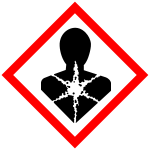 |
|---|---|
| Signal word |
Danger |
| Hazard statement(s) |
H315 Causes skin irritation H318 Causes serious eye damage H372 Causes damage to organs through prolonged or repeated exposure |
| Precautionary statement(s) | |
| Prevention |
P264 Wash … thoroughly after handling. P280 Wear protective gloves/protective clothing/eye protection/face protection/hearing protection/… P260 Do not breathe dust/fume/gas/mist/vapours/spray. P270 Do not eat, drink or smoke when using this product. |
| Response |
P302+P352 IF ON SKIN: Wash with plenty of water/… P321 Specific treatment (see … on this label). P332+P317 If skin irritation occurs: Get medical help. P362+P364 Take off contaminated clothing and wash it before reuse. P305+P354+P338 IF IN EYES: Immediately rinse with water for several minutes. Remove contact lenses, if present and easy to do. Continue rinsing. P317 Get medical help. P319 Get medical help if you feel unwell. |
| Storage |
none |
| Disposal |
P501 Dispose of contents/container to an appropriate treatment and disposal facility in accordance with applicable laws and regulations, and product characteristics at time of disposal. |
Other hazards which do not result in classification
no data available
Precautions for safe handling
NO open flames. Closed system, dust explosion-proof electrical equipment and lighting. Prevent deposition of dust. Handling in a well ventilated place. Wear suitable protective clothing. Avoid contact with skin and eyes. Avoid formation of dust and aerosols. Use non-sparking tools. Prevent fire caused by electrostatic discharge steam.
Conditions for safe storage, including any incompatibilities
The bulk material should be stored in well-closed container in a cool dry place.