


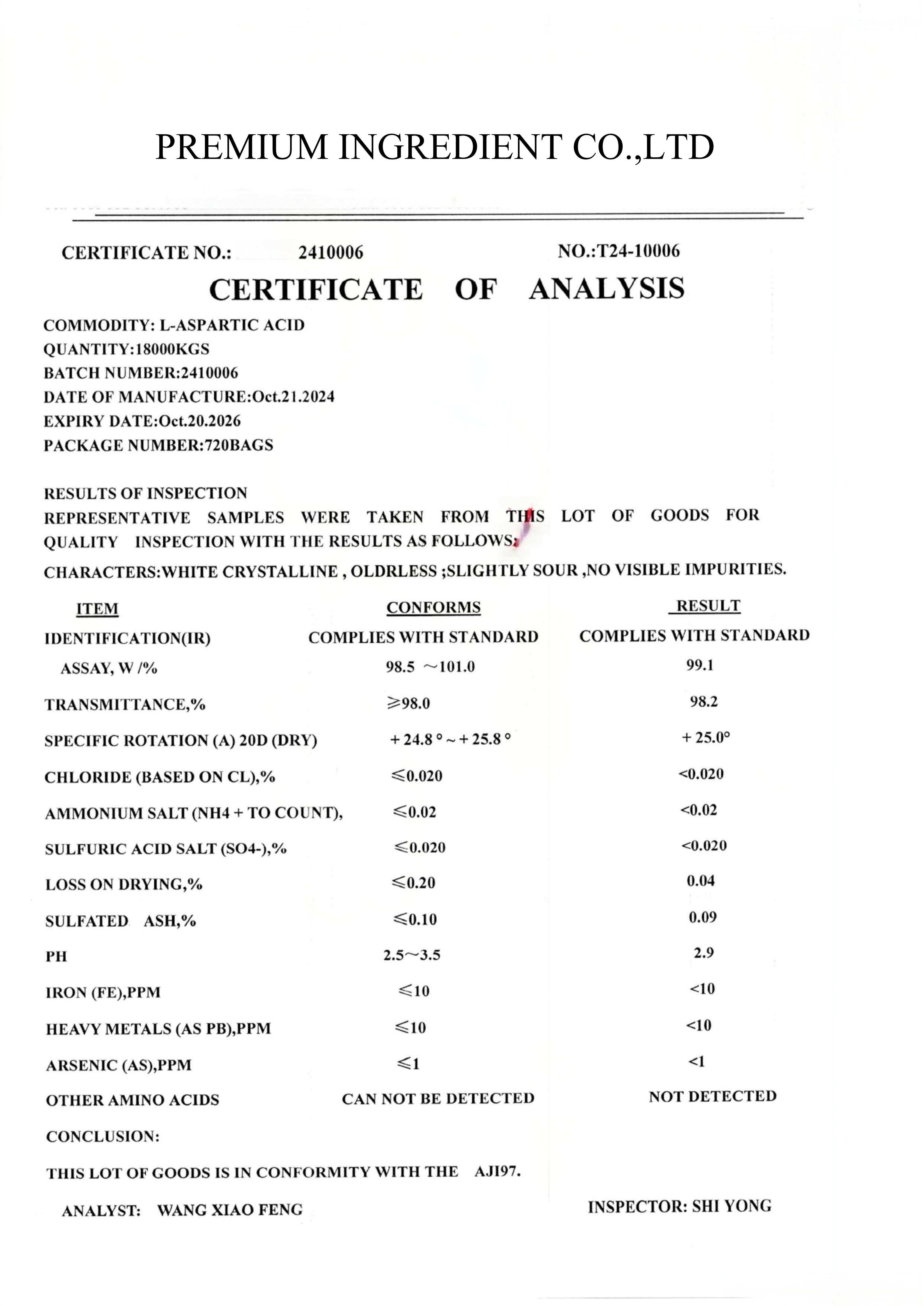
CERTIFICATE OF ANALYSIS
Product: L-Aspartic Acid
Quantity:
Batch No.:
Date of Manufacturer:
Expiry date:
|
ITEM |
SPECIFICATION |
TEST RESULT |
|
L-Aspartic acid |
≥98.5% |
99.3% |
|
Specific rotation |
+24.8° to +25.8° |
+25.0 |
|
Loss on drying |
≤0.20% |
0.06% |
|
Residue on ignition |
≤0.1% |
0.07% |
|
Lead |
≤5ppm |
<5ppm |
|
Identification test |
conform |
conform |
Conclusion: This lot of goods is in conformity with the FCC
| Product Name: | L-Aspartic acid | Other Name: | L-Aspartic acid;Aspartic acid,L-;L-Aminosuccinic acid;Asparagic acid;Asparaginic acid;Butanedioic acid,amino-,(S)-;Aspartic acid;L-Asparaginic acid;(S)-Aspartic acid;L-Asparagic acid;L-(+)-Aspartic acid;(S)-Aminobutanedioic acid;(+)-Aspartic acid;H-Asp-OH;NSC 3973;NSC 79553;(S)-2-Aminobutanedioic acid;(+)-L-Aspartic acid;6899-03-2;181119-33-5;2139279-07-3 |
| CAS No.: | 56-84-8 | Molecular Formula: | C4H7NO4 |
| InChIKeys: | InChIKey=CKLJMWTZIZZHCS-REOHCLBHSA-N | Molecular Weight: | 133.10300 |
| Exact Mass: | 133.10 | EC Number: | 254-327-0 |
| ICSC Number: | 1439 | DSSTox ID: | DTXSID7022621 |
| Color/Form: | White, crystalline solid|Orthorhombic bisphenoidal leaflets or rods | HScode: | 29224995 |
| Categories: | Amino Acids and Derivatives |
| PSA: | 100.62000 | XLogP3: | -2.8 |
| Appearance: | Liquid | Density: | 3 @ Temp: 12.5 °C”>1.661 g/cm3 @ Temp: 12.5 °C |
| Melting Point: | 270-271 °C | Boiling Point: | 264.1ºC at 760 mmHg |
| Flash Point: | 113.5ºC | Refractive Index: | 1.531 |
| Water Solubility: | H2O: 5 g/L (25 ºC) | Storage Conditions: | Store at RT. |
| Vapor Pressure: | 2.6X10⁻⁷ mm Hg at 25 deg C (est) | Toxicity: | LD50 intraperitoneal in mouse: 6gm/kg |
| Specific rotation: | Specific optical rotation: +25.0 deg (c= 1.97 g in 100 ml 6 N hydrochloric acid) at 20 °C/D | Taste: | Acidic/neutral |
| PKA: | 2.01(at 0 °C) | Henrys Law Constant: | Henry’s Law constant = 1.1X10⁻¹⁴ atm-cu m/mol at 25 °C (est) |
| Dissociation Constants: | 2.01 (at 0 °C)|pK1 = 1.92 (COOH); pK2 =3.87 (COOH); pK3 = 9.87 (amine) | Collision Cross Section: | 121.92 Ų [M-H]- [CCS Type: DT, Method: stepped-field]|122 Ų [M+H]+ [CCS Type: TW, Method: calibrated with polyalanine]|118.6 Ų [M-H]- [CCS Type: DT, Method: single field calibrated with ESI Low Concentration Tuning Mix (Agilent)]|118.7 Ų [M-H]- [CCS Type: DT, Method: single field calibrated with ESI Low Concentration Tuning Mix (Agilent)]|120.39 Ų [M-H]- [CCS Type: DT, Method: stepped-field]|119.8 Ų [M-H]- |
| Experimental Properties: | ASPARTIC ACID HAS RELATIVELY HIGH SOUR, RELATIVELY LOW MSG-LIKE TASTE INTENSITIES /ASPARTIC ACID/|DECOMPOSES AT 324 °C (RAPID HEATING)|Isoelectric point = 2.98|Forms supersaturated soln easily | Physical Dangers: | Dust explosion possible if in powder or granular form, mixed with air. If dry, it can be charged electrostatically by swirling, pneumatic transport, pouring, etc. |
Classification of the substance or mixture
Not classified.
GHS label elements, including precautionary statements
| Pictogram(s) | No symbol. |
|---|---|
| Signal word |
No signal word |
| Hazard statement(s) |
none |
| Precautionary statement(s) | |
| Prevention |
none |
| Response |
none |
| Storage |
none |
| Disposal |
none |
Other hazards which do not result in classification
no data available
Precautions for safe handling
NO open flames. Prevent build-up of electrostatic charges (e.g., by grounding). Closed system, dust explosion-proof electrical equipment and lighting. Prevent deposition of dust. Handling in a well ventilated place. Wear suitable protective clothing. Avoid contact with skin and eyes. Avoid formation of dust and aerosols. Use non-sparking tools. Prevent fire caused by electrostatic discharge steam.
Conditions for safe storage, including any incompatibilities
Separated from strong oxidants.