


| Chlorogenic Acid | |
| Chinese Name | 绿原酸 |
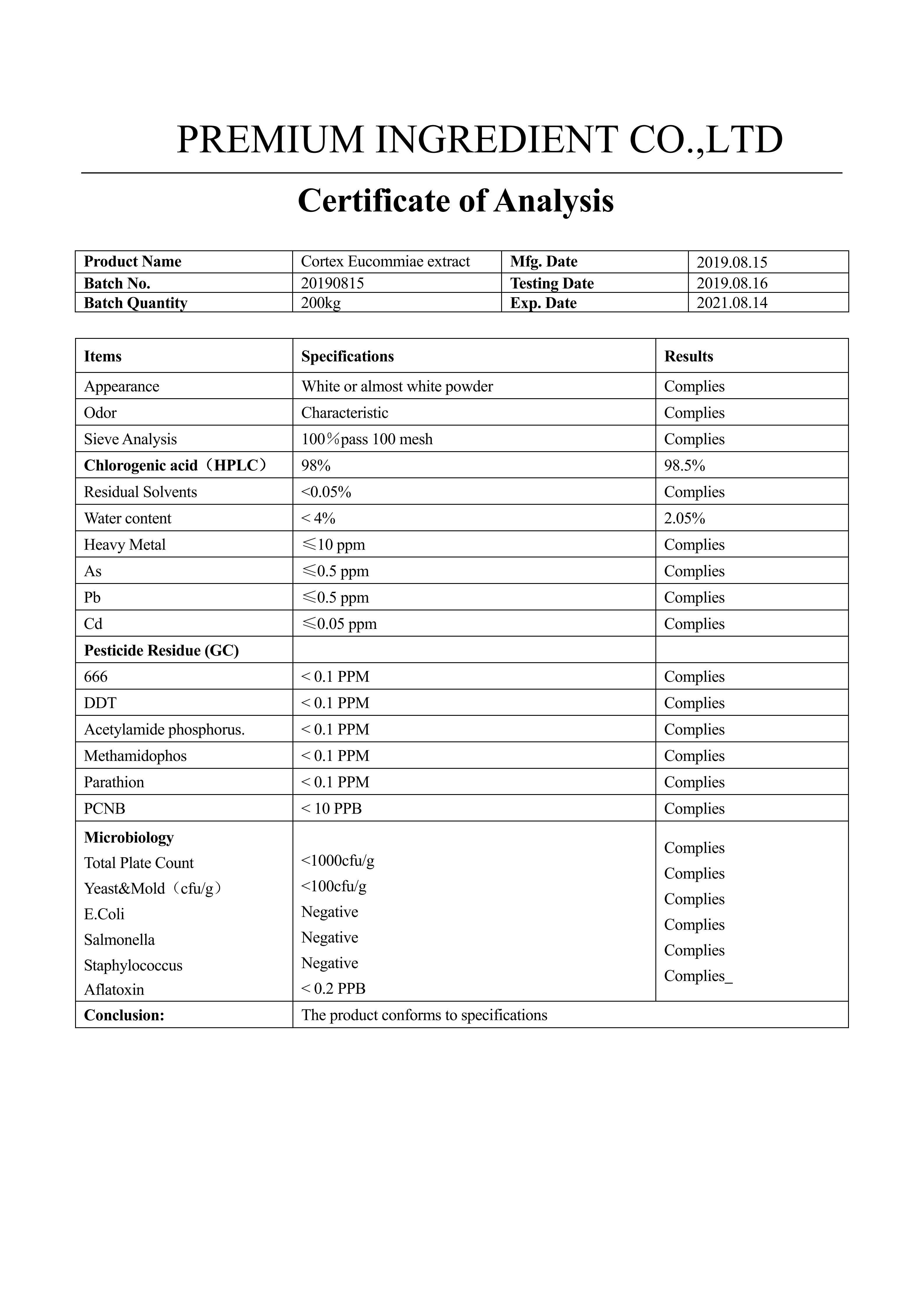
| Synonyms | Eucommia ulmoides bark (Cortex Eucommiae) extract, chlorogenic acid powder |
| CAS No. | 327-97-9 |
| Molecular Formula | C₁₆H₁₈O₉ |
| Molecular Weight | 354.31 g/mol |
| Primary Source | Bark of Eucommia ulmoides (Cortex Eucommiae) |
| Color | Chlorogenic Acid 98%: Off-white to very pale light yellow fine powder Low purity grades (5%,10%,25%,50%): Light yellow to yellowish-brown fine powder |
| Main Active Component | Chlorogenic Acid |
| Other Natural Sources | Green coffee beans, honeysuckle flowers |
| Specifications | Chlorogenic Acid 5%, 10%, 25%, 50%, 98% (HPLC) |
| Extraction Method | Water or ethanol extraction and purification from Eucommia ulmoides bark (Cortex Eucommiae) |

| Product Name: | Chlorogenic acid | Other Name: | Cyclohexanecarboxylic acid,3-[[3-(3,4-dihydroxyphenyl)-1-oxo-2-propen-1-yl]oxy]-1,4,5-trihydroxy-,(1S,3R,4R,5R)-;Chlorogenic acid;Cyclohexanecarboxylic acid,3-[[3-(3,4-dihydroxyphenyl)-1-oxo-2-propenyl]oxy]-1,4,5-trihydroxy-,[1S-(1α,3β,4α,5α)]-;Cyclohexanecarboxylic acid,3-[[3-(3,4-dihydroxyphenyl)-1-oxo-2-propenyl]oxy]-1,4,5-trihydroxy-,(1S,3R,4R,5R)-;(1S,3R,4R,5R)-3-[[3-(3,4-Dihydroxyphenyl)-1-oxo-2-propen-1-yl]oxy]-1,4,5-trihydroxycyclohexanecarboxylic acid;3-Caffeoylquinic acid;3-O-Caffeoylquinic acid;3-(3,4-Dihydroxycinnamoyl)quinic acid;Caffeoylquinic acid;3-O-(3,4-Dihydroxycinnamoyl)-D-quinic acid;NSC 407296;Heriguard;NSC 70861;SW 85834;5-Chlorogenic acid;108657-60-9;12626-41-4;15076-00-3;16310-14-8;16431-26-8;16431-25-7 |
| CAS No.: | 327-97-9 | Molecular Formula: | C16H18O9 |
| InChIKeys: | InChIKey=CWVRJTMFETXNAD-NCZKRNLISA-N | Molecular Weight: | 354.30900 |
| Exact Mass: | 354.31 | EC Number: | 206-325-6 |
| HScode: | 29182900 | Categories: | Plant Extracts |
| PSA: | 164.75000 | XLogP3: | -0.4 |
| Appearance: | Solid | Density: | 1.65g/cm3 |
| Melting Point: | 206-207 °C | Boiling Point: | 665ºC at 760mmHg |
| Flash Point: | 245.5ºC | Refractive Index: | -37 ° (C=1, H2O) |
| Water Solubility: | soluble in hot water;40 mg/mL at 25 °C | Storage Conditions: | 0-6ºC |
| Toxicity: | LDLo intraperitoneal in rat: 4gm/kg |
Classification of the substance or mixture
Skin irritation, Category 2
Eye irritation, Category 2
Specific target organ toxicity â single exposure, Category 3
GHS label elements, including precautionary statements
| Pictogram(s) |  |
|---|---|
| Signal word |
Warning |
| Hazard statement(s) |
H315 Causes skin irritation H319 Causes serious eye irritation H335 May cause respiratory irritation |
| Precautionary statement(s) | |
| Prevention |
P264 Wash … thoroughly after handling. P280 Wear protective gloves/protective clothing/eye protection/face protection/hearing protection/… P261 Avoid breathing dust/fume/gas/mist/vapours/spray. P271 Use only outdoors or in a well-ventilated area. |
| Response |
P302+P352 IF ON SKIN: Wash with plenty of water/… P321 Specific treatment (see … on this label). P332+P317 If skin irritation occurs: Get medical help. P362+P364 Take off contaminated clothing and wash it before reuse. P305+P351+P338 IF IN EYES: Rinse cautiously with water for several minutes. Remove contact lenses, if present and easy to do. Continue rinsing. P304+P340 IF INHALED: Remove person to fresh air and keep comfortable for breathing. P319 Get medical help if you feel unwell. |
| Storage |
P403+P233 Store in a well-ventilated place. Keep container tightly closed. P405 Store locked up. |
| Disposal |
P501 Dispose of contents/container to an appropriate treatment and disposal facility in accordance with applicable laws and regulations, and product characteristics at time of disposal. |
Other hazards which do not result in classification
no data available
Precautions for safe handling
Handling in a well ventilated place. Wear suitable protective clothing. Avoid contact with skin and eyes. Avoid formation of dust and aerosols. Use non-sparking tools. Prevent fire caused by electrostatic discharge steam.
Conditions for safe storage, including any incompatibilities
Store the container tightly closed in a dry, cool and well-ventilated place. Store apart from foodstuff containers or incompatible materials.